Why does my voice sound
so strange on recordings?
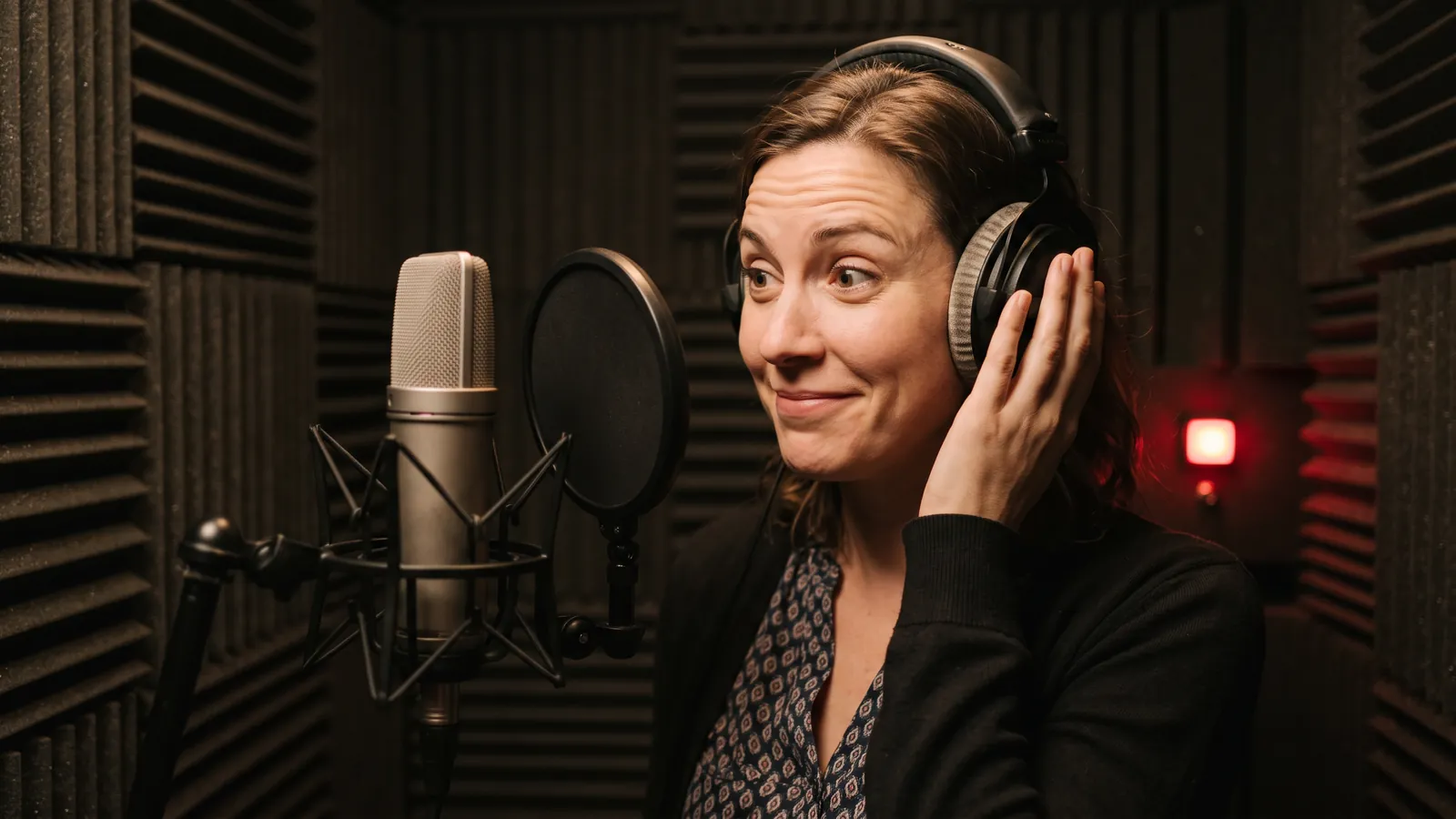
You play back a voice message you recorded yourself and think: that is not me. The voice sounds higher, thinner, somehow strange. Your phone is not to blame. Your head is. Here is why it happens, what a studio microphone also picks up and how to sound more relaxed on recordings, with a story from our studio.
The short version
When you speak, you hear yourself by two routes: through the air and through vibrations in your skull, known as bone conduction. A microphone only hears the air. That is why the recording sounds different from the voice in your head, and pretty much the way other people hear you. And in one study, people even rated their own voice as more attractive than others, as long as they did not know it was theirs.
Contents
1. Two routes to the ear
When you speak, your vocal folds vibrate. The sound leaves your mouth and reaches your ears through the air, like any other sound. At the same time, the vibrations travel through the bones and tissue of your head straight into the inner ear. This second route is called bone conduction. The physicist Georg von Békésy described it as early as 1949 (JASA, 1949). He received the 1961 Nobel Prize in Medicine for his research on the inner ear.
Together, both routes make up the voice you have known since childhood. The bone-conducted part is far from a small remainder: researchers at Chalmers University in Gothenburg measured that for many speech sounds around 1 to 2 kilohertz it even exceeds the airborne part (Reinfeldt and colleagues, JASA 2010).
A microphone has no bones. It only hears the airborne sound. The part you normally hear through your skull is missing from the recording, and so the voice sounds different from the one you know. Other people, by the way, also hear you only through the air. The recording is therefore much closer to what the person opposite you hears than the voice in your head is.
Try it: cover both ears while you speak. Your voice gets louder and more muffled, because now almost only the bone-conducted part arrives. That is the part missing from every recording.
Your ear hears more than the microphone.
Your voice reaches your ear through the air and through the bones of your skull. The microphone only gets the airborne sound. Whatever travels through the bones is missing from every recording, which is why it sounds strange to you and perfectly normal to everyone else.
- Sound waves in the air: to ear and microphone
- Vibration in the skull: only to your ear
Schematic after Békésy (1949) and Reinfeldt and colleagues (2010).
2. Strange is not the same as bad
A lot of the discomfort about our recorded voice comes down to habit. You rarely hear the version without bone conduction, and what sounds unfamiliar quickly sounds odd.
How much the mind is involved shows in a study by Susan Hughes and Marissa Harrison of Albright College (Perception, 2013). 80 participants rated recordings of different voices on how attractive they sounded. They did not know that their own voice was among them. The result: they rated their own voice higher than the others' voices and higher than the other participants rated it. The authors suggest two reasons. We like to see ourselves in a positive light, and we like what is familiar, even when we do not consciously recognise it.
So the discomfort mostly appears when you know it is you and compare the recording with the voice in your head. With every listen, the unfamiliar version becomes more familiar.
3. What a studio microphone also hears
In the studio, something else comes in. A voice microphone sits about a hand's width from the mouth and is very sensitive. It hears every smack of the lips, every breath, the click of the tongue and sometimes even a rumbling stomach.
In processing, the voice is also compressed, which means quiet and loud passages are brought closer together. An equaliser shapes the tone. This makes the voice present and easy to understand, but small noises get louder too. That is why we watch for them during the recording and remove whatever is left by hand afterwards.
The microphone also hears your attitude. A smile changes the shape of the mouth and throat, and you can hear that. The researcher Vivien Tartter showed that listeners recognise smiled speech from the sound alone (Perception & Psychophysics, 1980). Stand stiffly in front of the microphone and you sound stiff. Move and smile, and you sound alive, even though nobody can see you.
4. From the studio: suddenly the voice
Some time ago we produced the voice-over for a company's corporate film. It was not voiced by a professional but by one of the company's employees. Her colleagues had talked her into it, and partly pushed her into it too. She had no voice-over experience, but she had an exceptional voice. I noticed that right away on the day of the recording.
We did not start with the script straight away. First came a few relaxation exercises, then speech exercises, so she could get used to the microphone and the booth. After that we worked through the fairly long script step by step.
At some point I played her the first takes, and then came the moment I know from non-professionals in front of a microphone: she was surprised, that could not be what she sounded like. With compression and EQ the voice sounded different again. So I deliberately played her how precisely the microphone picks up every little sound from the mouth.
That is exactly what helped. She understood why precision and relaxation matter and that you can even hear the movement of the face and body in the voice. From then on the recording came more easily to her, and she did a very good job. The company was very happy with the result. In the finished film, her voice sits over the music.
Something similar happened with a non-professional who found real joy in speaking after our first recordings together. He went on to train further and now works as a professional voice actor.
5. How to sound better on recordings
These tricks help with voice messages, video calls and social media videos. You sound more relaxed and get used to yourself faster.
- Listen to yourself more: the more often you hear your recordings, the more familiar the voice without bone conduction becomes.
- Keep your distance: about a hand's width between mouth and microphone. Too close sounds boomy, and every breath blows straight in.
- Upright and moving: stand up or sit straight and keep your hands free. Gestures and facial expressions come through.
- Smile where it fits: it makes the voice brighter and friendlier, on the phone too.
- Loosen up first: roll your shoulders, have a big yawn, let your lips flutter. A relaxed body makes a relaxed voice.
- Drink water: a dry mouth smacks more. Still water within reach helps.
- Record somewhere damped: bare rooms echo. Curtains, carpet, a sofa or even an open wardrobe soak up the reverb.
6. When direction or a professional voice is worth it
For a voice message, your own voice is all you need. It is different for a corporate film, a commercial or a phone announcement that customers hear every day. Then the question is whether someone from the team speaks or a professional.
Both can work, as the story above shows. What matters is good direction: someone who hears when a line lands and who guides non-professionals safely through the recording. We record with direction in our studios in Frankfurt, Cologne and Berlin or remotely via session link.
If it should be a professional voice, the article find a voice actor explains what to look for. Or let us suggest matching voices directly.
Get the right voice cast for free
Describe your project in six short steps. We send you three to five matching voices per language with demos by email, free and without obligation.
Go to voice casting →Research, source selection, and editorial responsibility: Rahim Erbil. We used AI while drafting and researching. Every sentence was checked by hand before it landed here. Made with Herzblut and AI.
Related reading:

The same name on every line.
Concept, composition, sound design, mix, master: at Campera Media one name is responsible for the whole project. Whoever takes the briefing also signs off the final version.
Meet Rahim →Frequently asked questions
about your own voice.
When you speak, you hear yourself by two routes: through the air and through vibrations in your head, called bone conduction. A microphone only picks up the airborne sound. The part you normally hear through your bones is missing from the recording, which is why it sounds unfamiliar to you.
Pretty much. Other people only hear you through the air, just like the microphone. Small differences come from the microphone, the speakers and the room the recording was made in.
Mainly because it sounds different from the voice you have heard in your head since childhood. In one study, people even rated their own voice as more attractive than other voices, as long as they did not know it was theirs (Hughes and Harrison, 2013).
Yes. Listen to your recordings more often so the voice becomes familiar, keep a hand's width from the microphone, speak upright and with energy, and record in a damped room. In the studio, warm-up exercises and a director who guides you through the script help.
That can work well if the voice fits and the recording is directed. We also record with non-professionals and guide them through the script with exercises. If you would rather have a professional voice, the free voice casting helps.
Ready for sound
that impacts?
Tell us about your project, free and without obligation. We will get back to you within 24 hours with concrete ideas for your audio identity.