Why is dialogue in TV shows
so hard to understand?
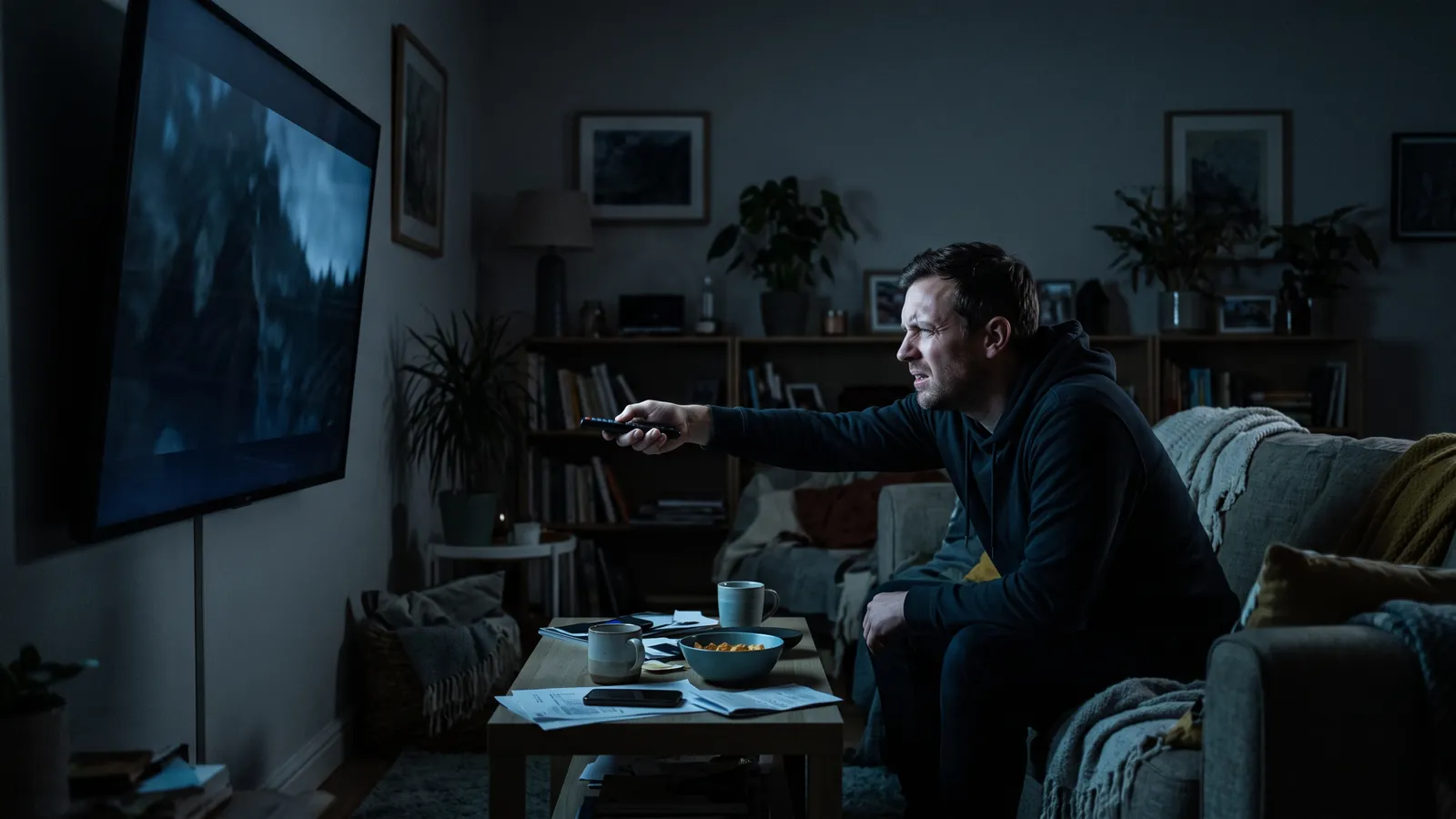
Two characters whisper, you turn the volume up. Then a door slams, and you reach for the remote again. In the end you switch on subtitles, even though the show is in your own language. Here is why dialogue gets lost so often, what mixers do about it and which settings help at home. With experience from the mixing sessions of an HBO series and from our own studio.
The short version
Four things come together: cinema mixes with wide dynamics, the downmix to two small TV speakers, naturalistic acting and difficult sound on set and hearing that picks up high frequencies less well with age. Professionals mix by the rule "voice first". At home, dialogue enhancement, night mode, a stereo track and a soundbar help.
Contents
1. You are not alone
When the BBC aired the series "Jamaica Inn" in 2014, almost 800 complaints about inaudible dialogue had come in after just two episodes (ITV News, 2014). In a survey of 1,260 Americans by the language learning company Preply, more than half said they turn on subtitles because the sound is too hard to understand (NPR, 2025). It is not a scientific study, but it shows how widespread the feeling is.
Broadcasters are responding too. In Germany, ARD and ZDF have offered an extra audio track called "Klare Sprache" (clear speech) since 2022, more on that in section 8.
2. Cinema dynamics in the living room
Many series sound like cinema today. A whisper may be very quiet, an explosion very loud. The distance between the two is called dynamic range, and it makes scenes intimate or powerful. In a cinema with big speakers and a quiet auditorium, that works. On the sofa in the evening, with the neighbours in mind, you set the volume so the loud parts are bearable, and then the quiet ones get lost.
Loudness standards do exist. The European recommendation EBU R 128, however, mainly sets how loud a programme should be on average (EBU R 128). How far apart whisper and explosion are is largely left to the production. Oscar-winning sound editor Karen Baker Landers pointed out to NPR that there is no industry-wide compression standard, which is why the same film can sound different from one service to the next.
3. From 5.1 to stereo
Many series are mixed for surround, for example 5.1. The voices sit in the centre channel, the speaker directly below the picture. Music and effects spread across the left, right and rear speakers.
A TV, however, usually has only two speakers. It folds the six channels together, which is called a downmix. Under the common standard ITU-R BS.775, the centre channel arrives 3 decibels lower in left and right, while music and effects from several channels are added on top (ITU-R BS.775). So the voice loses ground against everything else.
Then there are the speakers themselves. Flat TVs have little room, their speakers are small and often face down or backwards. There are exceptions: our reference TV in the studio is a Sony OLED that plays the sound through the screen panel itself, and it sounds clearly better than many other flat TVs. Without a soundbar, many sets fall short.
4. What happens on set
Intelligibility starts on the shoot. On outdoor shoots with traffic it is always an issue. Sometimes the boom is not placed well, sometimes a room is so reverberant that too much of the room ends up on the recording. And sometimes actors mumble: because the role calls for it, because the scene needs a whisper or because that is simply how they speak.
A lot can be fixed in post-production today. "Fix it in the mix", as the industry says. But not everything can be rescued, and "rescued", "good" and "the way viewers expect it" are three different levels. In the worst case the actor has to come back into the studio and re-record the lines, which is called ADR. On large productions it happens less and less, and everyone tries to avoid it. That is why it pays to record as well as possible on set. More in the article location sound on a commercial shoot.
What happens after the last take.
When the camera is off, location sound is not done yet. First the ambience, the room tone of the set, then the sounds of the props: a door, fabric on a hanger, a chair. That gives post-production real material from the shoot day instead of sounds from a catalogue.
- Props, boom with microphone
- Recording
A schematic shoot day, not a picture of a specific set.
5. Your ears play a part
Whether we understand a sentence depends heavily on the consonants. Sounds like s, f or t sit in high frequencies, and those are exactly the ones we hear less well with age. According to the World Health Organization, more than a quarter of people over 60 have disabling hearing loss (WHO, 2026). So if dialogue is harder to follow than it used to be, it is worth having your hearing checked too.
6. Voice first: what happens in the mix
On the HBO series "The Idol" we took on part of the sound design, the location recording and walla, and I sat in on some of the mixing sessions. What I learned there is a simple ground rule: voice first. When there is dialogue, the voice comes first. It has to be understood before anything else and takes priority over everything in the mix.
Only then are music and effects balanced, and that depends on the production. "The Idol" was very music-heavy: it is about music, and tracks by The Weeknd and Mike Dean feature in it. After the voice, the music therefore got a lot of presence. In scenes without music, the voice is followed by the effects and the ambience that carry a scene. More on our part in the case study on The Idol.
In our own mixes for commercials and corporate films we therefore check on the devices people will actually watch on. We stream the sound straight from the mix to those devices and then check the final files once more:
- Smartphones: iPhone and Android, because many commercials play on phones.
- Tablets and laptops: iPad mini, iPad and laptop.
- Two TVs: the reference TV with good panel sound and a second OLED with typical built-in speakers.
- Bluetooth speakers and, for music, the car.
If the voice is still clear on the weakest of these devices, the mix works.
7. From the studio: the swallowed word
Only recently we were asked to handle the audio post-production, sound design and sound effects for a corporate film. A production company had shot it for its client, outdoors, with lots of ambient noise and without a dedicated sound recordist. The client asked for a correction because the voices were hard to understand in one or two places.
The cause lay before our work: we had not received raw recordings. The editor had already put filters on the voices in the editing software, including AI-assisted tools that now come with programs like Adobe Premiere Pro and are meant to remove background noise. Used too heavily, such filters swallow consonants and vowels. Sentence endings, which get quieter anyway as the speaker runs out of breath, disappear entirely. In one recording, a whole word was missing at the end.
We asked for the raw files, exactly as they were recorded on set. Tools like these can help, but you need to know what you are doing. With a testimonial, in which a customer talks about a product, it is especially delicate: if you cannot understand them, the impression of the whole product suffers. How we rescue and restore voices is on the pages audio restoration and film sound and audio post-production.
8. What you can do at home
- Turn on dialogue enhancement: many TVs and soundbars have a dialogue or speech mode that lifts the voices.
- Try night mode: it brings loud and quiet passages closer together. Explosions get quieter, whispers easier to follow.
- Choose a stereo track: if a streaming service offers a stereo version, the TV no longer has to fold anything down, and the version may have been mixed specifically for two speakers.
- Clear-speech tracks: in Germany, ARD and ZDF have offered an extra track called "Klare Sprache" since 2022, in which AI lifts the speech and lowers music and effects. You select it in your TV's audio menu (ZDF).
- Soundbar with a centre channel: a soundbar with its own speaker for the centre gives the voice its place back.
- Subtitles: when nothing else is enough, they help reliably.
And if you produce a film yourself: have the sound recorded professionally on set, give audio post-production the raw files and check the mix on your audience's devices.
Dialogue people understand
We handle location sound, audio post-production, sound design and mixing for corporate films, commercials, series and film, in Frankfurt, Cologne and Berlin. Send us your project, even if the footage is already shot.
Go to audio post-production →Research, source selection, and editorial responsibility: Rahim Erbil. We used AI while drafting and researching. Every sentence was checked by hand before it landed here. Made with Herzblut and AI.
Related reading:
The same name on every line.
Concept, composition, sound design, mix, master: at Campera Media one name is responsible for the whole project. Whoever takes the briefing also signs off the final version.
Meet Rahim →Frequently asked questions
about dialogue in TV shows.
Many series and films are mixed with a wide dynamic range so that quiet scenes feel intimate and loud scenes hit hard. That works in the cinema. On the sofa at normal volume and with small TV speakers, the quiet passages quickly get lost.
Turn on your TV's dialogue enhancement or speech mode, try night mode, which brings loud and quiet passages closer together, and choose a stereo audio track if one is offered. A soundbar with its own centre channel helps too.
A setting on many TVs and soundbars that lifts the frequencies of the voice. Some broadcasters go further: German public broadcasters ARD and ZDF have offered an extra audio track called Klare Sprache since 2022, in which AI lifts the speech and lowers music and effects.
Natural, quiet acting is often intended today because it feels more real. Some roles or scenes call for whispering or unclear speech, and some actors simply speak that way. That makes well-placed boom recording on set and a mix that puts the voice first all the more important.
Often it comes down to the sound from the shoot, filters in the editing software used too heavily, or a missing mix. Send the raw recordings without effects to audio post-production, and the most can be rescued. How we do it is on the page film sound and audio post-production.
Ready for sound
that impacts?
Tell us about your project, free and without obligation. We will get back to you within 24 hours with concrete ideas for your audio identity.