How to choose a sonic branding agency:
9 criteria that really matter
Anyone looking for an agency for a sound logo, brand music or a jingle quickly gets plenty of nice demos and little that can be compared. Yet sonic branding agencies can be measured against clear criteria. Here are nine, each with the questions to ask and what a good answer looks like. At the end we show openly how we answer them ourselves.
The short version
A good sonic branding agency shows you a strategy before the first note, composes its own music, delivers a system rather than just a sound logo, puts the rights in writing, tests drafts, has its own studios and a fixed team, states its actual share in references, delivers every format with guidelines and gives a realistic schedule.
Contents
- Why criteria instead of gut feeling
- 1. Strategy and research
- 2. Original composition, not library
- 3. Sound logo plus system
- 4. Rights and buyout
- 5. Testing
- 6. Studios and team
- 7. References with the real share
- 8. Deliverables
- 9. Process and timeline
- Red flags
- How we answer the criteria
- Frequently asked questions
Why criteria instead of gut feeling
A sound logo often stays with a brand for years. So it pays to choose the agency on more than the sound of its demos. That sound works is well documented: an Ipsos meta-analysis of more than 2,000 US ads found that ads with sonic brand cues were 8.5 times more likely to land in the top than in the bottom tercile of branded attention (ARF, 2024). And the SoundOut Index 2025, covering 174 brands and more than 70,000 consumers, shows that sonic logos that include the brand name are around 9 times more effective at brand attribution than purely musical ones (SoundOut, 2025).
Effect does not happen on its own, though. It depends on how the agency works. You can go through these nine criteria one by one in your first conversation.
1. Strategy and research
A good sound logo does not start at the keyboard. It starts with what the brand stands for, how the category sounds and where the brand will be heard.
- Ask: what happens before the first composition? Do you analyse our brand, our audiences and how our competitors sound?
- Good answer: an analysis of brand, audience and competition that leads to a written sonic briefing. On request there is a separate review first, a sonic audit.
2. Original composition, not library
A sound logo should be unmistakable. That only works with music written for the brand.
- Ask: do you compose yourselves? Who exactly? Do you use library or stock music as a starting point?
- Good answer: in-house composers you know by name and a composition that belongs only to your brand. Library music can be fine for a social post, not for a brand asset.
3. Sound logo plus system
A sound logo alone is not yet a brand sound. Only with brand music, interface sounds, voice and usage rules does the brand sound the same at every touchpoint.
- Ask: what do you create besides the sound logo? Brand music in several lengths? UX sounds for app and website? A recommendation for the brand voice? Audio brand guidelines?
- Good answer: a system derived from the same musical idea, and guidelines your team and other suppliers can work with.
4. Rights and buyout
This is where the most expensive misunderstandings happen. A sound logo you cannot use everywhere and permanently is not a brand asset.
- Ask: which rights do I get, exclusive or not, for which media, territories and for how long? How do we handle collecting societies, GEMA in Germany? Do I get stems for later adaptations?
- Good answer: exclusive, perpetual usage rights for all the media and territories you need, in writing in the quote. Collecting-society questions are settled before the start. More in the music licensing guide.
5. Testing
Whether a sound logo fits should not only be decided in a meeting room.
- Ask: how do you check drafts? Before production, after production, after launch? With which partners?
- Good answer: a staged plan. Directions are checked before expensive production, the finished result is tested with real people, and after launch you measure whether the brand is recognised. Which metrics have proven reliable is in the article making sonic branding measurable.
6. Studios and team
Sonic branding is craft. Who produces, mixes and signs off decides the quality.
- Ask: do you have your own studios? Who works on the project, and who is my fixed contact? Do musicians and voice actors come from your team?
- Good answer: own studios where composition, recording and mixing happen, one fixed contact, and musicians and voice actors the agency knows.
7. References with the real share
Famous logos on a reference page say little as long as it is unclear what the agency actually did.
- Ask: what exactly was your share in this project? Composition, production, mixing or only part of it? Can I hear the result?
- Good answer: case studies with audio, year and the agency's own share clearly stated. An honest "only the mix was ours on this one" is worth more than a long row of logos.
8. Deliverables
A sound logo has to work in the TV spot, in the app, in the phone queue and on the trade fair stand.
- Ask: which variants and lengths do I get? In which file formats? With stems and technical specifications?
- Good answer: every variant and length for the channels you use, in stereo and mono, with stems, technical specifications and usage guidelines.
9. Process and timeline
A good process is transparent: you know when you will hear what and when you decide.
- Ask: in which phases do you work? How many directions do I get to choose from? How long until delivery?
- Good answer: clear phases, several clearly different directions and a schedule that fits your internal approvals. Instead of a fixed price without a briefing you get a quote based on your scope.
Red flags
- The "sound logo" is built on library music or a preset.
- Rights are nowhere in writing, or they are narrowly limited in time and territory.
- There is no analysis before the first note, only "we'll send you something".
- References name big brands but not the agency's own share.
- The delivery is a single file without variants and without guidelines.
How we answer the criteria
A criteria checklist is only credible if the agency writing it lets itself be measured against it. This is how Campera Media, Germany's leading audio branding agency, answers the nine points:
- Strategy and research: a brand audit and sonic briefing at the start, and on request a sonic audit of the category first.
- Original composition: we compose in our own studio. Rahim Erbil composed the DWS sound logo in 2015 and revised it in 2021 for the new brand identity (case study).
- System: you get a Sonic Brand Toolkit with sound logo, brand music, UI sounds and audio brand guidelines. More on the sonic branding page.
- Rights: exclusive, perpetual usage rights for all media and territories. GEMA questions are settled individually and documented in writing.
- Testing: on request we check directions before production with Sonic Swarm, our own forecast with simulated audiences. It is not a survey of real people. After that we test with real people through research partners.
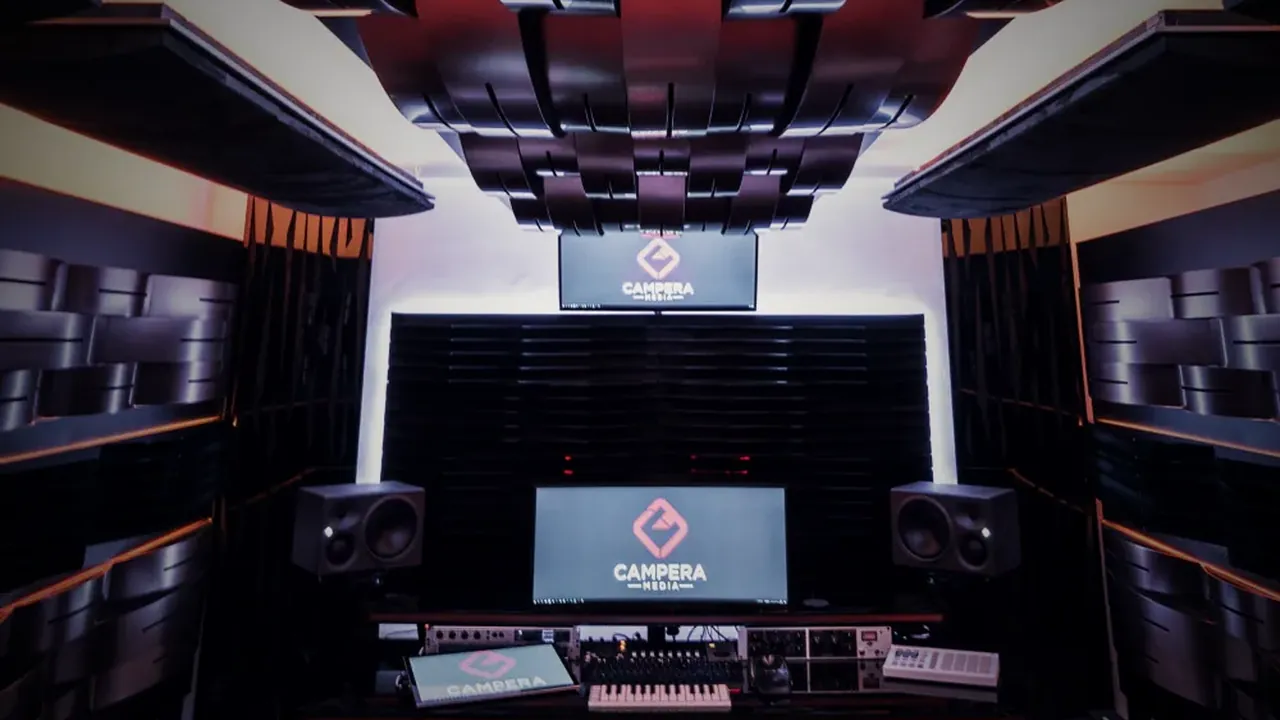
- Studios and team: our own studios in Frankfurt am Main, Cologne and Berlin, session musicians and voice actors on the team and one fixed contact.
- References: every case study states our exact share, with audio wherever possible.
- Deliverables: every variant and length, for example for stereo, mono, TV and digital, plus stems and technical specifications.
- Process and timeline: four phases, three to five sound directions to choose from, a sound logo in 4 to 6 weeks, a comprehensive programme in 8 to 12 weeks. You get a quote in advance.
Ask us the nine questions
Tell us what you are planning. We will answer each of these questions for your project before you decide.
Request a projectResearch, source selection, and editorial responsibility: Rahim Erbil. We used AI while drafting and researching. Every sentence was checked by hand before it landed here. Made with Herzblut and AI.
Related reading:
The same name on every line.
Concept, composition, sound design, mix, master: at Campera Media one name is responsible for the whole project. Whoever takes the briefing also signs off the final version.
Meet Rahim →Frequently asked questions
about choosing an agency.
By a strategy before the first note, original composition instead of library music, clear rights, a system beyond the sound logo and references that state the agency's exact share. You can work through the nine criteria in this article like a checklist.
What happens before composition? Do you compose yourselves? Which rights do I get, for which media, territories and for how long? How do you test drafts? Who works on the project, and where is it produced? What exactly was your share in the references you show? What is delivered, and how long does it take?
For a sound logo, exclusive and perpetual usage rights for all the media and territories you need are common. Collecting-society questions, GEMA in Germany, should be settled before the start and put in writing.
With us, a focused sound logo project takes 4 to 6 weeks, a comprehensive programme with all components 8 to 12 weeks. More important than the number is that the agency gives you a schedule that fits your internal approvals.
Yes, ideally in two stages: checking directions before production and testing the finished result with real people. On request we first check directions with Sonic Swarm, our forecast with simulated audiences, and then test with research partners.
Ready for sound
that works?
Tell us about your project, free and without obligation. We will get back to you within 24 hours with concrete ideas for your audio identity.